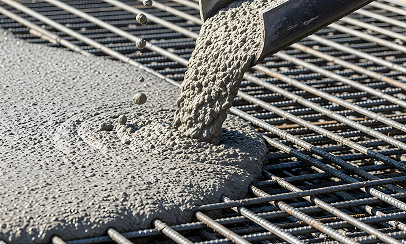
When you can’t get a mixing truck onto your site, concrete pumping is the best option. It makes delivering and pouring your concrete faster and easier in difficult to reach areas.
Whether you’re planning a home project or managing a construction site, this go-to guide to concrete pumping breaks down what it is, how it works and when it makes sense to use a concrete pump – so you know what to expect.
What is concrete pumping?
Concrete pumping is a method of moving freshly mixed concrete from the delivery truck to where it needs to go on your construction site using a pump and pipes or hoses.
That means you don’t need to rely on multiple trips back and forth with a wheelbarrow or a crane. The pump pushes the concrete through a pipeline (known as a pump line) under pressure, delivering it exactly where it’s needed, even in spots that are awkward to reach.
It’s essentially a controlled flow system: concrete goes in at one end and comes out precisely where you need it at the other.
Key benefits of concrete pumping
There’s a reason why concrete pumping is so widely used across projects of all sizes.
1. It saves time and labour
Pumping is much faster (and less laborious!) than manual methods as it removes the need for heavy lifting and constant movement across site.
2. It reaches difficult areas
From back gardens to high floors and tight access sites in city centres, pumps can deliver concrete where trucks can’t go.
3. It’s highly accurate
Concrete is placed exactly where it’s needed, which means less waste or extra handling.
4. It keeps projects moving
A constant, steady flow of concrete means fewer delays and a smoother workflow for your team.
Types of concrete pumps
There are two types of concrete pumps used across construction projects: line pumps and boom pumps. Here are the key differences and how they’re used.
Line pumps
- Use hoses laid along the ground
- More compact and easier to manoeuvre
- Great for domestic projects like driveways, extensions, and patios
Concrete line pumps are normally truck-mounted on an under-HGV chassis with a static pump mounted on the back. They’re compact in size, so very versatile and cost effective, making them best suited to smaller jobs like residential work.
Boom pumps
- Mounted on a truck
- Feature a long, robotic arm (the “boom”)
- Ideal for high-rise buildings or hard-to-reach areas
Typically used for large or complex jobs where speed and reach are key, boom pumps feature a hydraulic arm (known as a boom) mounted on the truck. They allow for large volumes of concrete to be dispersed accurately.


How does concrete pumping work?
Is it really as simple as ‘concrete goes in, concrete goes out’? In a nutshell, yes! But there’s a lot more going on behind the scenes to make the process as smooth as possible. Here’s exactly what happens on the day.
1. Planning and site setup
Before any concrete arrives, the pump operator will assess the site, looking at:
- Where the truck and pump can safely park
- The distance from the truck to the pour area
- Any obstacles like buildings, fences, or tight access points
- Ground conditions (important for stability, especially with larger boom pumps)
For boom pumps, the outriggers (stabilisers) are extended to keep the vehicle steady. For line pumps, hoses are carefully routed to avoid sharp bends that might affect the flow of concrete.
2. Setting up the pipeline
Once the pump is in position, the delivery line is assembled.
- Line pumps use connected steel or rubber pipes laid along the ground
- Boom pumps use a mechanical arm to position the hose
Each section is securely clamped together to prevent leaks or pressure loss. Even small gaps or loose connections can cause problems once pumping begins, so this step is done carefully.
3. Priming the system
Before concrete is pumped, the pipeline needs to be prepared using a priming material (often a cement slurry or specialist primer). This is pushed through the system first to coat the pipes and reduce friction. Without priming, the concrete could stick, especially at bends or joins in the pipe.
4. Feeding the pump
Concrete arrives ready mixed in a mixer truck and is poured into the pump’s hopper, which acts as a funnel. Inside the pump, a hydraulic system moves the concrete to create a steady, controlled pressure that pushes the mix into the pipeline.
5. Pumping the concrete
Once everything is running, the concrete is pushed through the pipeline to the discharge point.
- With a line pump, a hose operator directs the flow at the end of the pipe
- With a boom pump, the operator controls the arm to place concrete exactly where it’s needed
The concrete comes out under pressure, but in a controlled way, allowing for accurate placement. This is especially useful for foundations, slabs, or pours that need to be level and consistent.
Is all concrete ‘pumpable’?
No, not all concrete mixes are suitable for pumping.
To work properly, the mix needs to:
- Flow smoothly without separating
- Contain the right balance of water, cement, and aggregates
- Be consistent enough to move through bends and pipes
If the mix is too thick, it can block the line. Too wet, and it can separate and weaken.
Safety considerations
Concrete pumping is efficient, but it does involve high pressure, so safety matters.
Key points include:
- Keeping clear of hoses during operation
- Properly securing pipes and connections
- Stopping the pump before disconnecting equipment
Pipelines can move unexpectedly under pressure, so it’s essential that these works are carried out by trained operators and that proper procedures are followed at all times.
When to use concrete pumping
Concrete pumping is usually the best choice when:
- Access is limited (e.g. behind a house or inside a building)
- You’re working at height or depth
- Large volumes of concrete are needed
- You want a faster, cleaner, more efficient pour
Need concrete pumping for your project?
If you’re planning a pour and want it done efficiently (without the hassle of moving concrete by hand), concrete pumping is the way to go.
For more details or to arrange a pump for your project, find out more about our concrete pumping service or get in touch with our team. We’ll help you choose the right setup and make sure everything runs smoothly on the day.